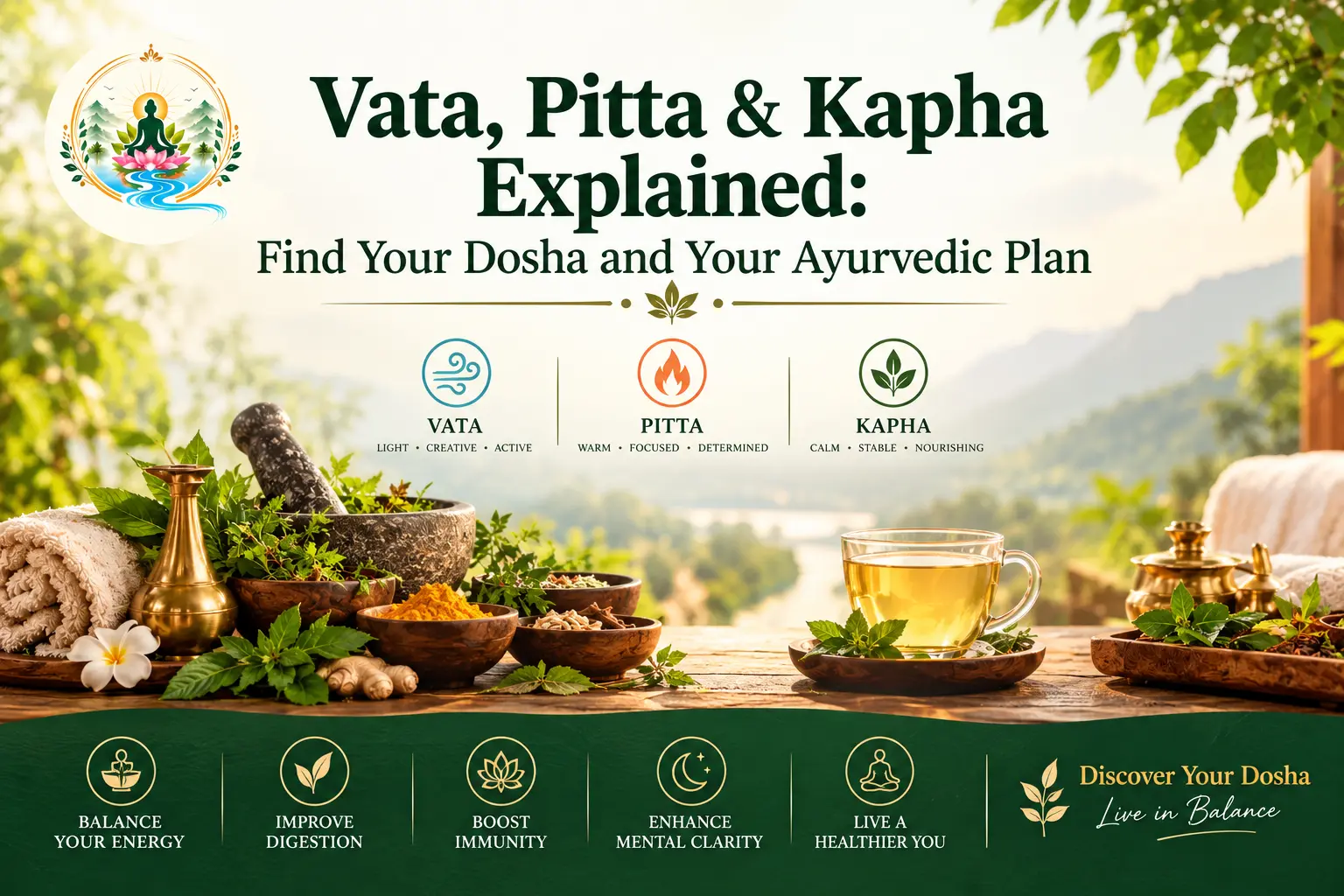
If you’ve read anything about Ayurveda, you’ve almost certainly come across the words Vata, Pitta, and Kapha. They are the three doshas, and they sit at the center of how Ayurveda understands your body, your habits, and your health.
They also explain something that surprises many first-time guests at an Ayurvedic retreat in Rishikesh why the person next to you at breakfast may be following a completely different treatment plan, even if you both arrived with the same complaint.
This guide explains what the doshas are in plain language, how to recognize the general traits of each, and how your dosha shapes the therapies, food, and routine you are given at a retreat.
What Is a Dosha?
In Ayurveda, a dosha is a type of functional energy that is believed to govern how the body and mind work. There are three:
Vata
Is associated with movement. It is traditionally linked to the qualities of air and space, and to breathing, circulation, and the nervous system.
Pitta
is associated with transformation. It is linked to fire and water, and to digestion, metabolism, and body heat.
Kapha
Is associated with structure and stability. It is linked to earth and water, and to the body’s strength, lubrication, and endurance.
Everyone has all three. What differs is the proportion. Ayurveda calls your natural balance your prakriti, a kind of baseline constitution. When daily habits, stress, food, or the weather push you away from that baseline, the result is called an imbalance (vikriti), and this is what ayurvedic treatment aims to address.
The Three Doshas at a Glance
Someone with a strong Vata nature tends to be quick, creative, and energetic in bursts. They often have a lighter frame, dry skin, and cold hands and feet. When Vata is out of balance, it may show up as anxiety, poor sleep, irregular digestion, or fatigue, and cold, dryness, skipped meals, and an irregular routine are traditionally seen as the usual triggers.
A strong Pitta nature is usually focused, driven, and sharp, often with a good appetite, a medium build, and a warm body. When Pitta is out of balance, it may appear as irritability, acidity, inflammation, or overheating. Heat, spicy food, pressure, and overwork are traditionally seen as the usual triggers.
Someone with a strong Kapha nature tends to be calm, steady, and patient, with good stamina, a sturdier build, and smooth skin. When Kapha is out of balance, it may show up as sluggishness, weight gain, congestion, or low motivation. Cold and damp weather, heavy food, and inactivity are traditionally seen as the usual triggers.
These are general patterns, not rules. Most people are a mix, often with one or two doshas more prominent than the third.
Why Your Dosha Matters at a Retreat
This is where the doshas stop being theory. Because the same symptom can come from different imbalances, Ayurveda does not treat people by complaint alone.
Take poor sleep as an example. In one person it may be traditionally understood as a Vata pattern, with a restless mind and irregular routine. In another, it may point to excess heat and a Pitta pattern. The therapies, food, and daily rhythm suited to each can look quite different.
At a retreat, this can influence:
- Therapies: the choice of oils, the type of massage, and which procedures are suitable.
- Food: Satvik meals are light and easy to digest, and your doctor may adjust warmth, spice, and heaviness to your constitution.
- Routine: timing of sleep, meals, and activity.
- Panchakarma: which procedures are used, in what order, and at what intensity.
A few broad examples of how this is traditionally approached:
- A Vata imbalance is usually addressed with warmth, grounding, regular routine, and nourishing oil-based therapies.
- A Pitta imbalance usually calls for cooling, calming approaches and avoiding excess heat and intensity.
- A Kapha imbalance usually calls for lighter food and more stimulating, energizing practices.
Why a Consultation Beats an Online Dosha Quiz
Online what is my dosha quizzes are a fun starting point, but they have real limits. They rely on self-reporting, and people often answer based on how they feel on one particular day. They also cannot account for your health history, medications, or how your body is behaving right now.
At The Neeraj Ganga Wellness Retreat, every stay starts with a one-on-one consultation with an Ayurvedic doctor. Your health history, current condition, and lifestyle are reviewed, and your plan is built from that, not from a questionnaire score. If you already took a quiz, that’s fine. Treat the result as a conversation starter, not a verdict.
How Dosha Fits Into Panchakarma
Panchakarma is Ayurveda’s traditional detoxification process, and your dosha is one of the factors that shapes it. Procedures such as Abhyanga, Shirodhara, Basti, and Nasya are chosen and sequenced according to what the doctor finds, rather than offered as a fixed package.
This is also why a panchakarma retreat in Rishikesh needs a consultation first. Panchakarma is not suitable for everyone. If you are pregnant, taking regular medication, or managing a medical condition, share this before booking so the doctor can confirm what is appropriate for you.
Can Your Dosha Change?
Your baseline constitution is considered fairly stable through life. But your current balance changes all the time. Season, stress, sleep, diet, and age all influence it. Ayurveda traditionally pays close attention to this, which is why guidance often shifts through the year and why many people return to Panchakarma periodically rather than once.
Frequently Asked Questions
Do I need to know my dosha before booking an Ayurvedic retreat?
No. Your dosha and current balance are assessed during your doctor consultation. You can arrive without any prior knowledge of Ayurveda.
Can I be more than one dosha?
Yes. Most people are a combination, with one or two doshas more prominent. Ayurveda looks at the overall pattern, not a single label.
Is an online dosha test accurate?
Quizzes can give a rough idea, but they cannot replace an assessment by an Ayurvedic doctor, who also considers your health history and current condition.
Does my dosha decide which Panchakarma treatment I get?
It is one of the factors. The doctor also considers your health history, current condition, season, and goals when planning panchakarma treatment.
Is panchakarma therapy suitable for every dosha?
Panchakarma is individualized. Whether it is appropriate, and how it is adapted, is decided during consultation rather than by dosha alone.
The Takeaway
Knowing your dosha is less about putting yourself in a box and more about understanding why a one-size-fits-all approach rarely works. At a well-run retreat, your dosha and your current condition guide the therapies, meals, and routine you are given, which is why a consultation-first approach matters.
If you would like to explore ayurvedic treatment in Rishikesh, India, with a plan built around you, learn more about The Neeraj Ganga Wellness Retreat.